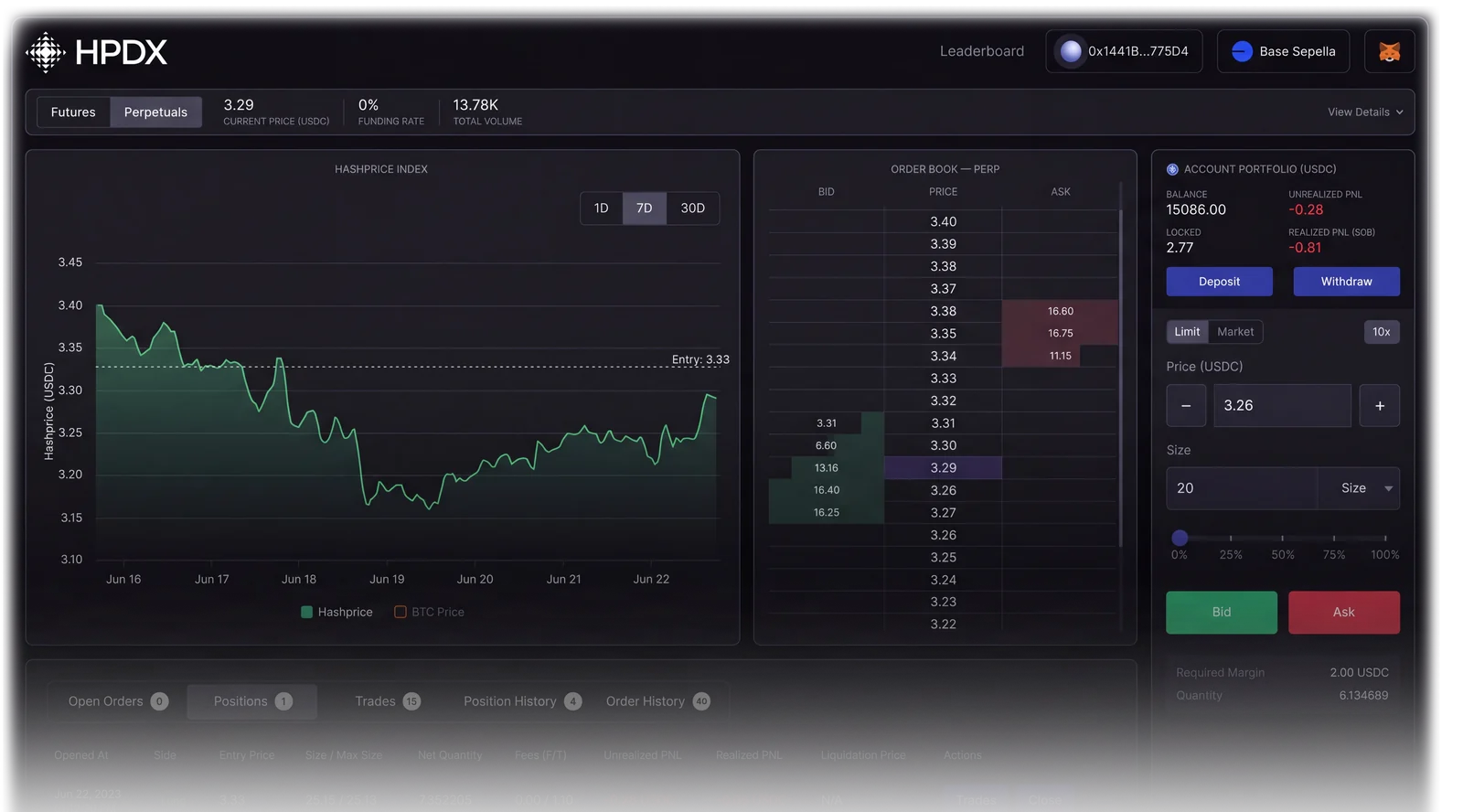

Hashrate Futures
Dated · Cash-settled
Launching First
Lock in future pricing through standardized, cash-settled contracts.
The first decentralized exchange of its kind
HPDX turns Bitcoin mining economics into a liquid, on-chain market.
Define trading rules and deploy an AI agent that trades continuously.
Positions mark to a hashprice feed that updates on-chain in real time.
Gain hashrate exposure without buying hardware or managing operations.
Lock in future pricing through standardized, cash-settled contracts.
Capture long-term market trends without expiration or contract rolls.
Turn volatility into opportunity, with your risk defined from the start.
Enter your email below to be notified when hashrate futures open for trading on Base.
Everything you need to know about trading hashrate derivatives on HPDX.
A hashrate derivative is a financial contract whose value tracks the hashprice index, the revenue a miner earns per unit of computing power. HPDX offers futures, perpetuals, and options on hashrate, letting miners and traders hedge or speculate on the commodity that secures Bitcoin, all settled on-chain.
Hashrate futures launch first on Base, with weekly contracts of 1 PH/s and cash or physical settlement. Perpetuals follow in Q3 2026 alongside the Founding Traders program, with options, a Chainlink oracle, and cross-chain deployment targeted for H2 2026. Register your email above to be notified as each phase opens.
You open a position by posting USDC margin to an audited smart contract. The hashprice index updates continuously via a Chainlink oracle, and contracts settle against the final index value, with cash or physical settlement paid directly to your wallet. There are no bilateral negotiations and no counterparty credit risk.
HPDX has a fixed supply of 10 billion with no inflation. It powers the protocol through fee buyback-and-burn, agent bonding, oracle and keeper staking, fee discounts of up to 40% for stakers, and governance yield. Twenty percent of protocol revenue flows to stakers who participate in governance.
Yes. HPDX is the first DEX built for AI agents. Connect any agent via the open SDK, post an HPDX bond, and it can execute strategies 24/7. Misconduct triggers slashing of the bond, while strong performance generates a revenue share for stakers, with a transparent on-chain track record per agent.
Drop your email above and we'll notify you the moment hashrate futures open for trading on Base. Once live, you'll connect a wallet, fund it with USDC, and can open your first position.
Hashpower tokenization is the process of representing Bitcoin mining capacity, measured in units like terahashes per second (TH/s), as a tradable financial instrument. Instead of buying physical mining rigs, hosting them, and managing electricity contracts, a trader can gain or hedge exposure to hashrate through a contract. HPDX applies this idea to derivatives rather than spot ownership, so a futures or perpetual contract tracks the price of hashpower without requiring anyone to hold or operate actual mining hardware.
Hashpower derivatives are financial contracts whose value is derived from the price of Bitcoin mining hashrate, commonly expressed through a metric called hashprice. A hashprice figure shows how much revenue a miner earns per unit of hashrate over a given period, factoring in block rewards, transaction fees, and network difficulty. A hashpower derivative lets a trader take a position on where that figure is headed, similar to how an oil futures contract lets a trader take a position on crude prices without taking delivery of barrels.
HPDX, short for HashPower Derivatives Exchange, is a decentralized exchange built on Base for trading hashrate futures and perpetual contracts. It's designed for anyone who wants exposure to Bitcoin mining economics, whether that's a miner hedging future revenue, a fund building a thesis around network difficulty, or a trader who simply wants a new source of uncorrelated volatility. The protocol runs on-chain, so positions, collateral, and settlement logic are governed by smart contracts rather than a centralized order book operator.
HPDX offers weekly hashrate futures denominated in 100 TH/s units. Each contract lets a trader lock in a price for a future period, with immediate cash settlement. A miner expecting difficulty to rise, and revenue per TH/s to fall, can sell a future to lock in today's economics ahead of time. A trader with the opposite view can take the buy side. Because the contracts settle weekly, the exposure stays tied to near-term market conditions rather than distant, hard-to-forecast periods.
Futures on HPDX have a fixed expiry, currently structured on a weekly cycle, and settle in cash or physically once that period ends. Perpetuals have no expiry at all. They track the underlying hashprice continuously through a funding rate mechanism that periodically transfers payments between long and short positions to keep the contract price aligned with the spot reference. Traders who want to hold a position indefinitely, adjusting it as conditions change, tend to prefer perpetuals. Traders who want a defined settlement point tend to prefer futures.
HPDX plans to source its hashprice reference through a Chainlink oracle, bringing verified off-chain mining economics data on-chain in a way that's resistant to manipulation. This matters for a derivatives protocol because every position, funding payment, and settlement calculation depends on that reference price being accurate and tamper-resistant. Rather than relying on a single centralized data feed, an oracle network aggregates and validates pricing data before it ever touches a smart contract.
Mining revenue is volatile. It moves with Bitcoin's price, with network difficulty, with transaction fee activity, and with the miner's own operating costs like electricity. A miner who wants predictable cash flow for the next quarter can sell hashrate futures to lock in today's economics, similar to how a farmer might sell a futures contract on next season's wheat. This doesn't eliminate the underlying business risk of running a mining operation, but it gives an operator a way to plan around a known number instead of an uncertain one.
Yes. That's one of the core reasons this market exists. Gaining exposure to Bitcoin mining economics traditionally required capital for hardware, a place to host it, an electricity contract, and ongoing maintenance. A hashrate future or perpetual on HPDX removes all of that. A trader opens a position with collateral, and the contract's value moves with the underlying hashprice reference, the same way an index future lets someone trade a stock index without buying every underlying share.
No. HPDX is built as a decentralized protocol on Base, meaning collateral and positions are held and managed through smart contracts rather than a company-controlled custodial account. Traders connect a wallet, post collateral, and interact directly with the protocol's contracts. This is different from a centralized exchange, where deposits sit in an account controlled by the exchange operator.
HPDX is built on Base, an Ethereum layer-2 network. Building on Base gives the protocol access to a growing ecosystem of DeFi infrastructure, lower transaction costs than Ethereum mainnet, and settlement finality suited to a derivatives platform where timing and collateral accuracy are important.
Hashprice generally moves with Bitcoin's price, since mining revenue is largely denominated in BTC and its dollar value. But hashprice is also affected by network difficulty and by how much of the network's total hashrate is competing for the same fixed block reward. A rising Bitcoin price with rapidly rising difficulty can produce a very different hashprice outcome than a rising Bitcoin price with flat difficulty. This is part of why hashpower derivatives exist as their own asset class rather than as a simple proxy for Bitcoin's spot price.
Like any derivative product, hashrate futures and perpetuals carry risk. Prices can move against a position, leverage can amplify losses as well as gains, and funding payments on perpetuals can work for or against a trader depending on market conditions. Anyone trading these instruments should size positions with that volatility in mind and understand the mechanics of settlement, funding, and collateral requirements before opening a trade.
HPDX is built for a range of participants: institutional trading desks looking for a new uncorrelated asset class, traditional traders exploring Bitcoin mining exposure without operational overhead, DeFi protocols and treasuries seeking diversified on-chain instruments, and crypto-native retail traders who want direct access to hashrate markets. Each of these groups approaches the protocol differently, but all of them share the same underlying need for transparent, on-chain access to hashpower price movement.
Trading Bitcoin gives a trader exposure to the asset's price. Trading a hashpower derivative gives exposure to the economics of mining that asset, which is a related but distinct variable. Bitcoin's price and network hashrate don't always move together. Difficulty adjustments, halving events, energy costs, and shifts in miner capitulation or expansion can all push hashprice in a direction that diverges from spot BTC price action over a given stretch of time. A trader who wants exposure to mining profitability specifically, rather than to the coin's price alone, is better served by a hashpower derivative than by a spot Bitcoin position.
Like most leveraged derivatives platforms, HPDX uses collateral thresholds to protect the protocol and other traders from undercollateralized positions. If the value of a trader's collateral falls below the required maintenance margin as the market moves against their position, the position can be liquidated to close out the exposure before losses exceed the posted collateral. This is a standard mechanic across derivatives markets, on-chain and off, and it's why position sizing and margin monitoring matter for anyone trading with leverage.
HPDX is built as a decentralized, non-custodial protocol, which means the core trading experience is designed around wallet-based access rather than a traditional account signup flow. Specific access requirements can vary by jurisdiction and by the front-end a trader connects through, so anyone unsure about their local requirements should check the current terms on the HPDX interface before trading.
Bitcoin's network difficulty adjusts roughly every two weeks to keep block production near a ten-minute average, regardless of how much total hashrate is competing on the network. When more mining capacity comes online, difficulty rises to compensate, which means each individual unit of hashrate earns a smaller share of the fixed block reward. When miners go offline or hashrate growth slows, difficulty falls, and each remaining unit earns a larger share. This relationship is a major driver of hashprice, and it's part of what makes hashpower derivatives a distinct market from simply trading Bitcoin's spot price.
Minimum position sizing depends on the specific contract and its unit denomination, such as the 100 TH/s increments used for weekly futures. These parameters are visible directly in the trading interface and can be adjusted over time as new markets and contract types are added to the protocol.
The current focus is on hashrate futures and perpetuals, which cover the core use cases of hedging and speculating on mining economics. Options are on the protocol's roadmap as a future addition, which would give traders more ways to structure exposure, such as capping downside risk while retaining upside, or generating income against an existing position. Timing for options and other contract types will be shared as development progresses.